Author name: bhcarbonsadmin

u24830891772044876743fm253app138fJPEG

Graphite Machining: Techniques, Applications, and Advanced Solutions (1)

1 Overview of Graphite Machining Graphite machining is a specialized manufacturing process that transforms graphite materials into precise components for industrial applications. Unlike conventional metal machining, graphite processing requires unique techniques and tools due to its combination of properties: excellent electrical and thermal conductivity, corrosion resistance, and high-temperature stability, coupled with low hardness but high abrasiveness. This unique combination enables […]

Graphite Machining: Techniques, Applications, and Advanced Solutions (1) Read More »
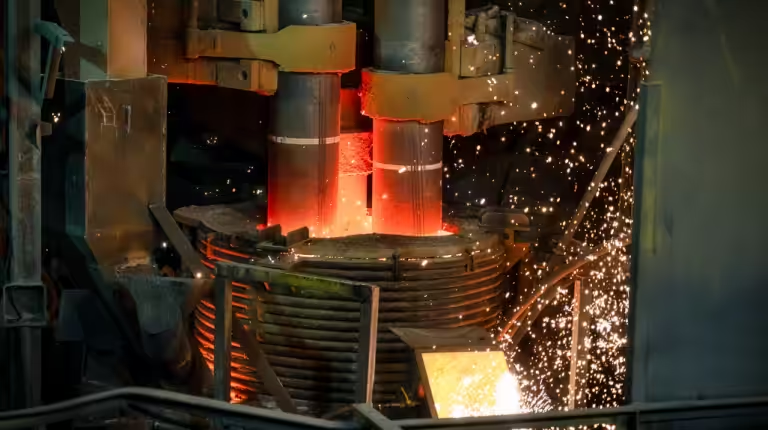
Graphitization Furnaces in Graphite Electrode Manufacturing 768x430 1

Graphite Furnace Technology: Industrial Applications and Operational Principles

1. System Definition and Core Functionality A graphite furnace is an ultra-high-temperature processing system utilizing medium-frequency induction heating (1-10 kHz) capable of reaching >3000°C. This equipment enables: Material purification (99.999% carbon purity) Controlled graphitization (crystallinity enhancement) Precision thermal processing (±5°C uniformity) Primary Applications: Electrode manufacturing Crucible production Nuclear-grade graphite processing Graphite Furnace Structural Diagram 2. Critical Subsystem Components

Graphite Furnace Technology: Industrial Applications and Operational Principles Read More »

Reasons for Graphites High Melting Point

Graphite Phase Transition Analysis: Sublimation Behavior and Thermal Stability

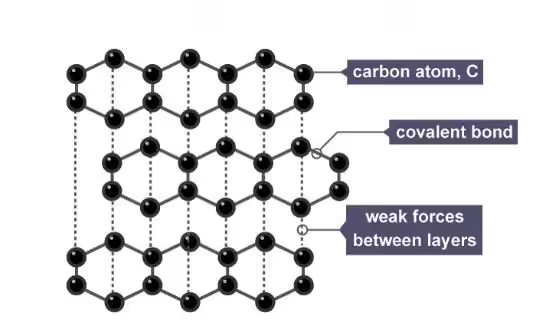
Fundamental Phase Characteristics Graphite exhibits atypical phase transition behavior distinct from conventional materials: Sublimation Point: 3,600°C (6,512°F) at standard pressure Melting Phenomenon: Only occurs under extreme pressure (>100 atm) Triple Point: 100 atm / 4,500 K (theoretical) Graphite Phase Diagram: Pressure vs Temperature Structural Determinants of Thermal Stability Crystalline Architecture Intralayer Bonding: sp² hybridized covalent

Graphite Phase Transition Analysis: Sublimation Behavior and Thermal Stability Read More »

Effectively Reduces Friction 1

Technical Advantages of Graphite Powder as Dry Lubricant: 6 Key Benefits

1. Friction Reduction Mechanism Coefficient of Friction: 0.08-0.15 (ASTM D2714) Operational Impact: 40-60% reduction in mechanical wear 15-30 dB noise attenuation Thermal load reduction by 35-50% Mechanism: Lamellar carbon structure enables interlayer slippage under shear stress 2. Extreme Condition Performance Environment Competency Limitation High Temp Stable to 450°C (air) / 3000°C (inert) Oxidizes >450°C in

Technical Advantages of Graphite Powder as Dry Lubricant: 6 Key Benefits Read More »

Graphite as Refractory Material

Comprehensive Analysis of Graphite Powder: Production and Applications

Material Fundamentals Graphite powder is a finely divided carbonaceous material characterized by its dark hue and exceptional physicochemical properties. With carbon content typically exceeding 99%, this material exhibits: Thermal conductivity: 100-400 W/(m·K) Electrical resistivity: 10⁻⁵–10⁻³ Ω·m Chemical inertness across pH 0-14 environments Industrial Production Process Stage 1: Mineral Extraction Underground mining operations targeting graphite-bearing metamorphic

Comprehensive Analysis of Graphite Powder: Production and Applications Read More »

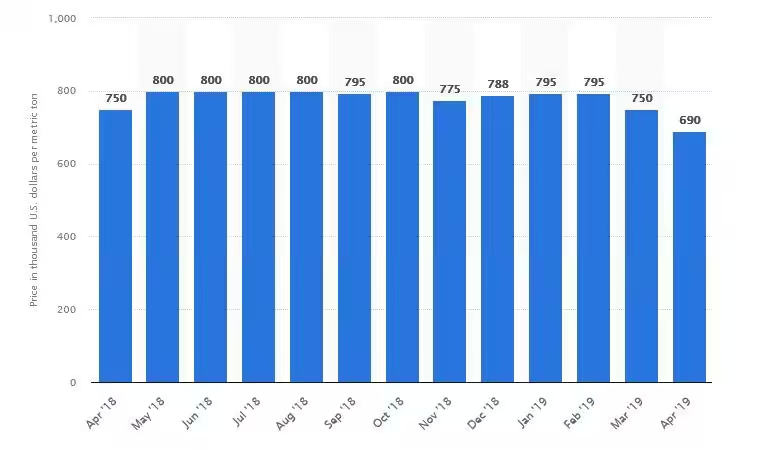
Figure 1 Graphite Price

Graphite Market Pricing Dynamics and Mechanisms

Core Pricing Characteristics As a non-futures traded commodity, graphite exhibits unique pricing attributes: Bilateral Negotiation Mechanism: >80% transactions priced through direct buyer-seller negotiations Market Transparency Limitations: Absence of unified exchange quotation systems Volume Discount Effect: Bulk procurement prices 30-50% lower than retail Price Determinants Matrix Factor Price Fluctuation Range Case Study Form & Specification $500-9,800/t

Graphite Market Pricing Dynamics and Mechanisms Read More »

Figure 3 Graphite structure

Properties and Applications of Carbon Graphite Materials

Material Composition and Characteristics Carbon graphite is a synthetic composite material formed by combining an amorphous carbon matrix with flake graphite, exhibiting a steel-gray to deep black gradient. Its core properties derive from a unique dual-phase structure: Property Category Performance Specifications Mechanism Thermal Stability Oxidative (200-600°C) Inert (≤3000°C) Cryogenic (-270°C) Stability of sp²-hybridized carbon network

Properties and Applications of Carbon Graphite Materials Read More »

Graphite Electrodes used in Electrolysis

In-Depth Analysis of Graphite’s Thermal Properties

Intrinsic Thermal Conductivity Graphite exhibits exceptional heat transfer capabilities among carbon allotropes, with in-plane thermal conductivity reaching 1500-2000 W/(m·K)—significantly surpassing copper (~400 W/(m·K)). This originates from: Delocalized π-electron system via sp² hybridization Rigid lattice structure with strong covalent bonds Phonon-dominated heat transfer mechanism (~4300 W/(m·K) at room temperature) Key Thermophysical Parameters Property Value Range Physical

In-Depth Analysis of Graphite’s Thermal Properties Read More »

IMG 20221229 171001 1

RP Graphite Electrode Landing Page

Who are we? Our main products are RP Graphite Electrode, Calcined Petroleum Coke, Graphitized Petroleum Coke, UHP/HP Graphite electrodes and other Graphite products. Our factory is located in the “Changxiang Industrial Park” of North China Carbon Base in Shanxi and Liaoning Province. The entire factory covers an area of 88,000 square meters, with the construction area of 42,800 square

RP Graphite Electrode Landing Page Read More »

Scroll to Top

Get A Free Quote Now !

Contact Form Demo (#3)